.png&w=3840&q=75)
Anyone who has commissioned clothing from a tailor understands the ritual: measurements, a fitting, an adjustment, then another return. With an established tailor the results can be extraordinary; without that understanding of the body, the process can be unpredictable.
That experience shaped the way I thought about ỌNUỌRA. I wanted to retain what I love about African tailoring while solving one of its greatest barriers to scale: fit.

01
Designing for Movement

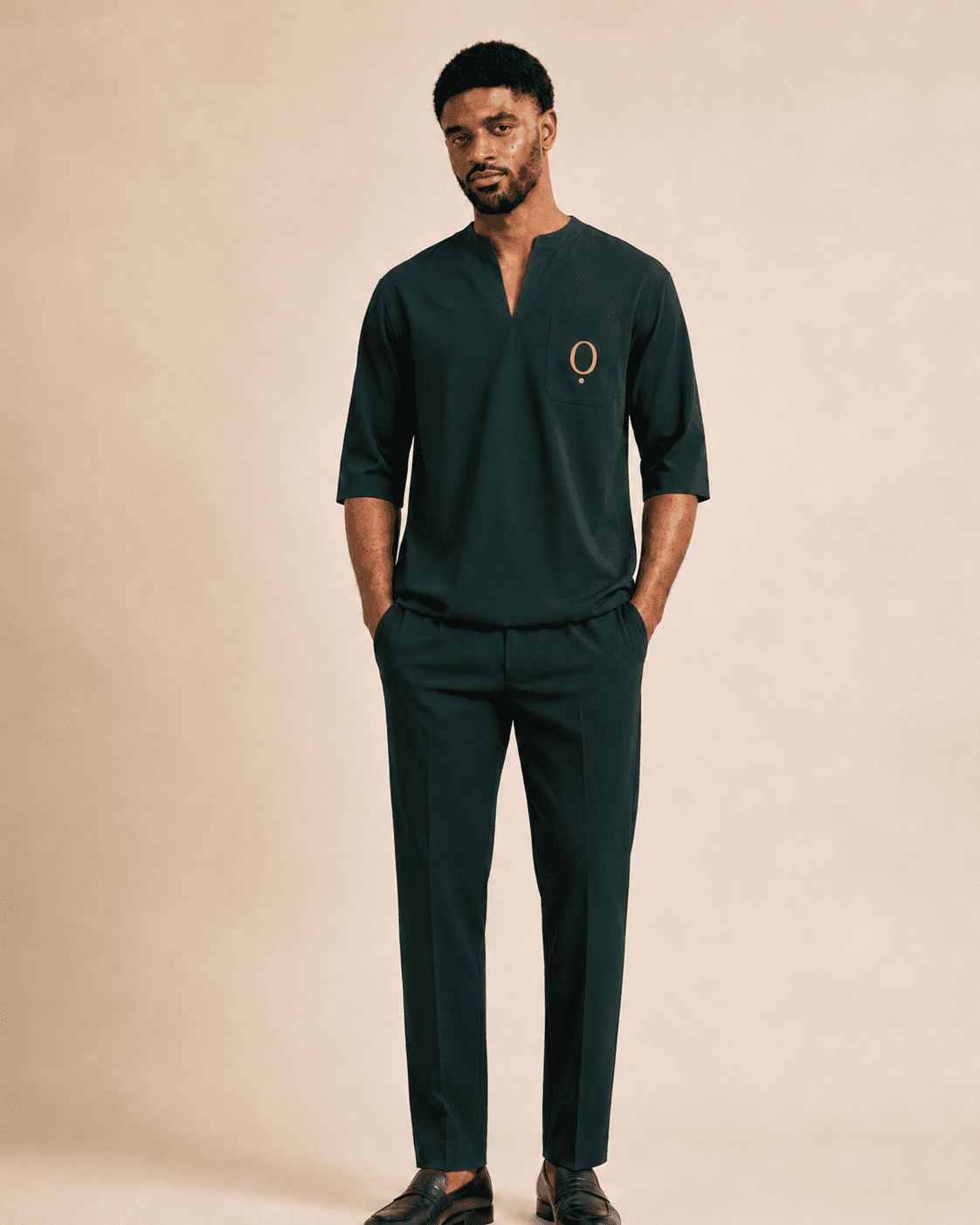
Our approach begins with fabric. We deliberately seek materials with an element of stretch so an ỌNUỌRA garment can breathe and move with the person wearing it.
Ready-to-wear African menswear should accommodate natural variation without requiring every customer to undergo an individual tailoring process. The trousers are cut with room to sit, walk and move while retaining a clean silhouette.
“The objective is simple: the precision of tailoring without the inconvenience traditionally associated with having something individually made.House of ỌNUỌRA

01
Designing for Movement
Our approach begins with fabric. We deliberately seek materials with an element of stretch so an ỌNUỌRA garment can breathe and move with the person wearing it.
Ready-to-wear African menswear should accommodate natural variation without requiring every customer to undergo an individual tailoring process. The trousers are cut with room to sit, walk and move while retaining a clean silhouette.
“The objective is simple: the precision of tailoring without the inconvenience traditionally associated with having something individually made.House of ỌNUỌRA
02
The Inside Matters Too

We have become increasingly uncompromising about finishing. A garment cannot simply photograph beautifully—turn it inside out, look at the seams, stitching, edges and the details the customer may never show anyone else.
Quality is often found where nobody expects you to look. The inside of an ỌNUỌRA garment should meet the same standard we demand of the outside.
02
The Inside Matters Too
We have become increasingly uncompromising about finishing. A garment cannot simply photograph beautifully—turn it inside out, look at the seams, stitching, edges and the details the customer may never show anyone else.
Quality is often found where nobody expects you to look. The inside of an ỌNUỌRA garment should meet the same standard we demand of the outside.
03
Made Here
There is another principle at the centre of the house: we make in Africa. Our fabrics and components are sourced on the continent, and our garments are produced in Nigeria by African hands.
This is not always the easiest approach. Manufacturing elsewhere can be faster, cheaper and easier to scale, but ỌNUỌRA exists partly because I believe Africans must demonstrate our capacity to do for self.
If the house succeeds, it should create work, develop skills and circulate money here. It should show what Nigerian craftsmanship and African manufacturing can become when we demand increasingly high standards from ourselves.
Every garment carries its place of origin: designed in Africa, sourced in Africa and made in Nigeria—with the intention of showing what is possible.
03
Made Here
There is another principle at the centre of the house: we make in Africa. Our fabrics and components are sourced on the continent, and our garments are produced in Nigeria by African hands.
This is not always the easiest approach. Manufacturing elsewhere can be faster, cheaper and easier to scale, but ỌNUỌRA exists partly because I believe Africans must demonstrate our capacity to do for self.
If the house succeeds, it should create work, develop skills and circulate money here. It should show what Nigerian craftsmanship and African manufacturing can become when we demand increasingly high standards from ourselves.
Every garment carries its place of origin: designed in Africa, sourced in Africa and made in Nigeria—with the intention of showing what is possible.
In This Article
More from the Journal
View all articles


Explore the Permanent Collections
Three silhouettes. One considered wardrobe.